
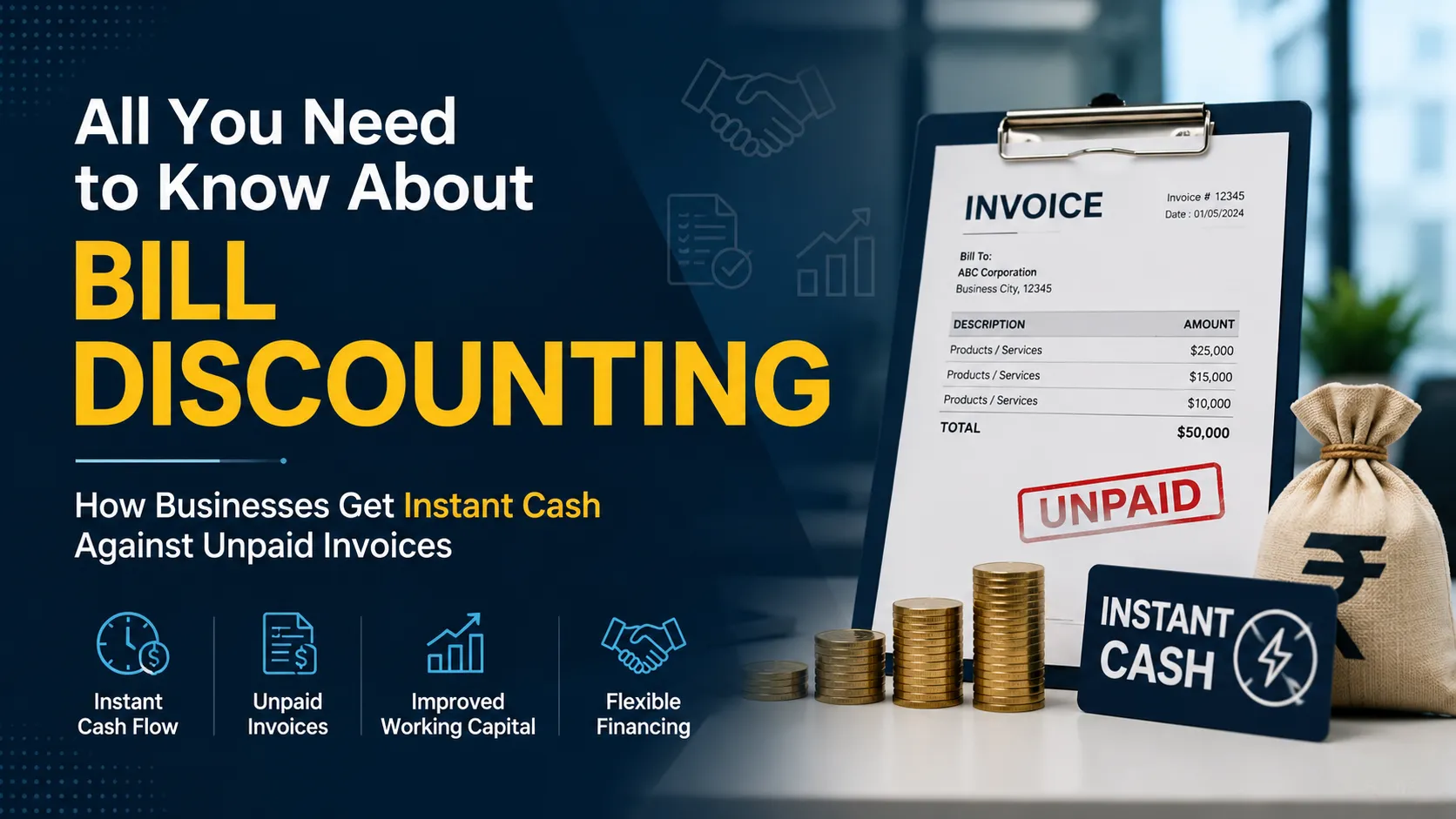
Know About Bill Discounting : Every business requires a steady flow of funds to operate smoothly. Whether it is purchasing raw materials, paying employees, meeting operational expenses, or expanding operations, liquidity plays a crucial role in business success. However, many businesses often face cash flow challenges because customers purchase goods or services on credit and take weeks or months to make payments. During this waiting period, companies may struggle to maintain adequate working capital.
To overcome such financial challenges, businesses use various financing methods. One of the most effective and widely used methods is Bill Discounting. Bill discounting allows businesses to convert their unpaid invoices or bills into immediate cash without waiting for customers to make payments. It serves as an excellent short-term financing solution, especially for businesses involved in trade and commerce.
Bill discounting is a financial arrangement where a bank, financial institution, or lender advances funds against an unpaid bill or invoice before its maturity date. In return, the lender charges a discounting fee. This enables businesses to improve cash flow, meet urgent financial requirements, and continue operations without interruption.
This article provides a comprehensive understanding of bill discounting, including its meaning, working process, features, advantages, disadvantages, eligibility, and importance in modern business finance.
Also Read : Check Out the Best Stock Market App for Stock Analysis in 2026
What is Bill Discounting? Know About Bill Discounting
Bill discounting is a financing method through which a business receives immediate funds against outstanding invoices or bills before their due date. Instead of waiting for customers to pay after a specified credit period, the business can approach a bank or financial institution and receive most of the invoice amount in advance.
The lender deducts a certain fee, known as the discounting charge, and releases the remaining amount to the seller. Once the bill reaches maturity, the customer pays the full invoice amount to the lender, who recovers the advanced funds.
In simple words, bill discounting enables businesses to access money that is due in the future, allowing them to maintain liquidity and manage working capital efficiently.
Bill discounting is also commonly known as Invoice Discounting because it involves financing against invoices raised on customers.
Also Read : 5 Features You Didn’t Know About iTunes
Understanding the Need for Bill Discounting
Many businesses sell products or services on credit terms ranging from 30 to 180 days. While credit sales help attract customers and increase revenue, they often create cash flow gaps.
For example, suppose a manufacturing company sells goods worth $100,000 to a customer with a payment term of 90 days. Although the sale has been completed, the company will receive payment only after three months. During this period, it still needs money to pay suppliers, workers, rent, and other operational expenses.
Rather than waiting for 90 days, the company can discount the bill through a lender and receive immediate funds. This helps maintain business continuity and prevents cash shortages.
Bill discounting is therefore considered one of the most efficient working capital financing solutions for businesses.
Also Read : Top 10 Most Popular Video Games in the World
Parties Involved in Bill Discounting
There are generally three parties involved in a bill discounting transaction:
1. Drawer
The drawer is the seller who supplies goods or services and raises the bill or invoice on the buyer. The drawer requires immediate funds and approaches a financial institution for bill discounting.
2. Drawee
The drawee is the buyer who purchases goods or services and is obligated to make payment on the due date.
3. Financier or Discounting Institution
The financier can be a bank, Non-Banking Financial Company (NBFC), or other financial institution that purchases or discounts the bill and provides immediate funds to the seller.
These three parties work together to facilitate the bill discounting process.
How Does Bill Discounting Work?
The bill discounting process is relatively simple and transparent. The following steps explain how it works:
Step 1: Sale of Goods or Services
A seller supplies goods or services to a customer on credit and generates an invoice or bill.
Step 2: Bill Submission
The seller approaches a bank or financial institution and submits the bill for discounting.
Step 3: Verification
The lender verifies the authenticity of the invoice, creditworthiness of the buyer, and other relevant documents.
Step 4: Fund Disbursement
After approval, the lender releases a major portion of the invoice value to the seller after deducting discounting charges.
Step 5: Maturity of the Bill
The bill reaches its due date according to the agreed credit period.
Step 6: Payment Collection
The buyer makes payment against the invoice. Depending on the arrangement, the payment may be collected by the lender directly or routed through the seller.
Step 7: Settlement
The lender recovers the advanced amount and completes the transaction.
Through this process, businesses gain quick access to funds without taking traditional loans.
Example of Bill Discounting
Consider a simple example:
A company sells products worth $50,000 to a customer with a 60-day credit period.
Instead of waiting for 60 days, the company approaches a bank for bill discounting.
The bank agrees to discount the invoice at a fee of 2%.
Invoice Amount: $50,000
Discounting Fee (2%): $1,000
Amount Released to Seller: $49,000
After 60 days, the customer pays the full $50,000 to the bank.
In this arrangement:
- The seller receives immediate funds.
- The bank earns $1,000 as discounting income.
- The buyer continues to enjoy the original credit period.
This demonstrates how bill discounting benefits all parties involved.
Types of Bill Discounting
1. Recourse Bill Discounting
Under recourse bill discounting, if the buyer fails to pay the invoice on the due date, the seller remains responsible for repayment to the lender.
This is the most common form of bill discounting.
2. Non-Recourse Bill Discounting
Under non-recourse bill discounting, the lender bears the risk of non-payment by the buyer.
The seller is not liable if the customer defaults.
Since the lender assumes greater risk, the discounting charges are usually higher.
Features of Bill Discounting
Bill discounting possesses several unique features that make it attractive for businesses.
Quick Access to Funds
Businesses receive immediate liquidity without waiting for customer payments.
Short-Term Financing
Bill discounting is generally used for short-term funding requirements.
Minimal Documentation
Compared to traditional loans, documentation requirements are relatively simple.
Flexible Financing
Funding is linked directly to sales transactions and invoices.
Improved Cash Flow
Businesses can bridge cash flow gaps effectively.
No Need for Additional Collateral
Many bill discounting arrangements rely primarily on invoice value and buyer credibility.
Advantages of Bill Discounting
Bill discounting offers numerous benefits to businesses of all sizes.
Improved Working Capital
One of the biggest advantages is enhanced working capital availability. Businesses can meet daily expenses without financial stress.
Faster Business Growth
Immediate access to funds allows businesses to accept larger orders and expand operations.
Lower Cost Compared to Loans
In many cases, bill discounting is more affordable than traditional business loans because interest is charged only for the remaining credit period.
Better Cash Flow Management
Regular cash inflow helps companies maintain stable operations and avoid disruptions.
No Equity Dilution
Unlike raising funds through investors, bill discounting does not require businesses to surrender ownership or control.
Increased Financial Flexibility
Companies can use funds for inventory purchases, payroll, supplier payments, marketing, and expansion.
Simple Approval Process
Since financing is based on invoices and buyer creditworthiness, approvals are often quicker than conventional loans.
Disadvantages of Bill Discounting
Despite its benefits, bill discounting also has certain limitations.
Discounting Charges
Businesses must pay fees to obtain early access to funds.
Dependence on Buyer Creditworthiness
Approval depends significantly on the financial strength and payment history of customers.
Limited Financing Amount
Funding is restricted to invoice values and cannot exceed outstanding receivables.
Risk Under Recourse Arrangements
If the buyer defaults, the seller may still be liable for repayment.
Not Suitable for All Businesses
Companies with limited credit sales may not benefit significantly from bill discounting.
Bill Discounting vs Business Loan
Many businesses compare bill discounting with traditional business loans.
| Basis | Bill Discounting | Business Loan |
| Purpose | Financing against invoices | General business funding |
| Collateral | Often not required | Usually required |
| Approval Time | Faster | Slower |
| Repayment | Through invoice collection | Fixed installments |
| Cost | Discounting fee | Interest charges |
| Flexibility | Linked to sales | Fixed borrowing limit |
Bill discounting is particularly useful for businesses facing temporary cash flow shortages, whereas business loans are more suitable for long-term funding needs.
Industries That Commonly Use Bill Discounting
Bill discounting is widely used across various industries, including:
Manufacturing
Manufacturers often sell products on extended credit terms and use bill discounting to maintain liquidity.
Wholesale Trade
Wholesalers rely heavily on invoice financing to manage inventory and supplier payments.
Export Businesses
Exporters frequently use bill discounting against letters of credit and export invoices.
Logistics and Transportation
Transportation companies use invoice discounting to finance operational expenses.
Retail Supply Chains
Suppliers serving large retail chains often experience delayed payments and benefit significantly from bill discounting.
Eligibility for Bill Discounting
Although requirements vary among lenders, businesses generally need:
- Valid business registration
- Active operations for a minimum period
- Genuine invoices or bills
- Creditworthy customers
- Good transaction history
- Bank statements and financial records
Lenders may also evaluate turnover, profitability, and industry risk before approving financing.
Factors Affecting Bill Discounting Charges
The discounting fee charged by lenders depends on several factors:
Creditworthiness of the Buyer
A buyer with strong financial standing reduces risk and attracts lower charges.
Invoice Value
Larger invoice amounts may qualify for better rates.
Credit Period
Longer credit periods generally result in higher discounting costs.
Seller’s Credit Profile
Businesses with strong financial records may receive favorable terms.
Industry Risk
Certain industries carry higher risk and may attract higher charges.
Importance of Bill Discounting in Modern Business
In today’s competitive environment, businesses cannot afford to wait for months to receive customer payments. Cash flow disruptions can affect operations, growth plans, and profitability.
Bill discounting plays a critical role in modern business finance by converting receivables into immediate working capital. It supports business continuity, reduces dependence on expensive loans, and enhances financial flexibility.
The increasing adoption of digital lending platforms and fintech solutions has made bill discounting even more accessible for small and medium-sized enterprises (SMEs). Businesses can now upload invoices online and receive funding within a short period.
As global trade continues to expand, bill discounting remains an essential financial tool that helps businesses manage liquidity and seize growth opportunities.
Conclusion
Bill discounting is one of the most effective and convenient financing solutions available to businesses today. It allows companies to unlock the value of unpaid invoices and receive immediate funds without waiting for customer payments. By improving cash flow, strengthening working capital, and reducing financial stress, bill discounting supports business growth and operational efficiency.
The process is simple, transparent, and generally less expensive than many traditional borrowing options. While businesses should carefully evaluate discounting charges and customer creditworthiness, the overall benefits often outweigh the costs.
Whether you are a manufacturer, trader, exporter, wholesaler, or service provider, bill discounting can serve as a valuable financial tool for managing cash flow and ensuring smooth business operations. Understanding how bill discounting works and using it strategically can help businesses maintain liquidity, capitalize on growth opportunities, and achieve long-term success.





1 thought on “All You Need to Know About Bill Discounting: How Businesses Get Instant Cash Against Unpaid Invoices ”
Mahi
Verified content creator on this website.
7 Facts That Prove Gold Loans to Be a Convenient Lending Option
7 Facts That Prove Gold Loans to Be a Convenient Lending Option : Friends, life has a way…
Read MoreCheck Out the Best Stock Market App for Stock Analysis in 2026
Best Stock Market App for Stock Analysis : The Indian stock market has witnessed tremendous growth over the…
Read More